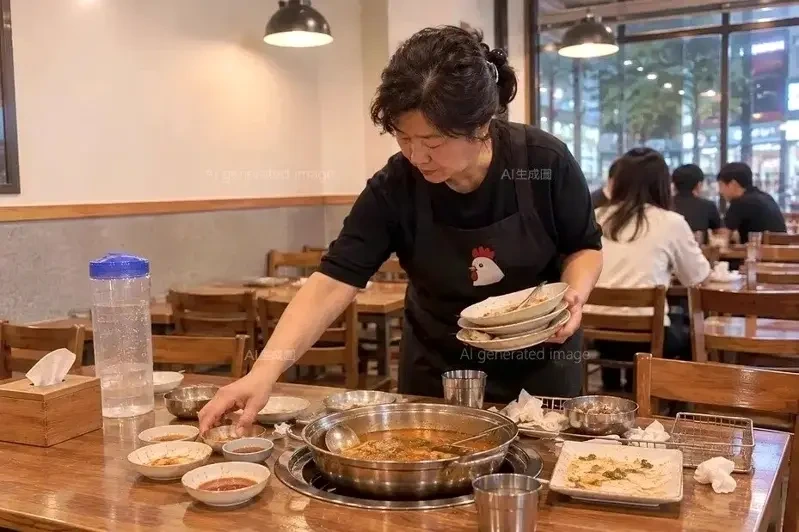
A “Dakhanmari” (whole chicken soup) restaurant in Seoul’s Dongdaemun district has come under fire after a netizen alleged that the establishment reuses leftover garlic and chives—cleared from one table—by serving them to other customers. The emergence of a video capturing this practice has sparked serious concerns regarding food safety and hygiene.
A popular culinary staple in Seoul’s Dongdaemun area is now embroiled in a food safety controversy. A netizen recently took to social media to report that, while dining at a “Dakhanmari” restaurant, they witnessed a staff member clearing a table and recycling uneaten garlic and chives—placing them aside to be served to other patrons. The individual, who left the restaurant early due to a sudden stomachache, expressed alarm, wondering if the leftovers from their own meal might have also been served to someone else.
According to the South Korean news outlet News1, the controversy stems from a post shared on a social media platform. The user, identified as “Mr. A,” released footage showing the restaurant’s kitchen area, alleging that the establishment engages in the unacceptable practice of recycling food ingredients. In an indignant post, Mr. A wrote: “Even if a customer has only touched the food a little, recycling leftover garlic and chives to serve to other people—isn’t that just going too far?” The post has since triggered a major outcry online.
In the video provided by Mr. A, a female restaurant employee can be seen working at a kitchen counter, which is cluttered with metal containers holding ingredients, as well as various bowls and plates. She is shown busily sorting through tableware and leftover food. Mr. A noted that throughout his meal, he repeatedly observed staff clearing dishes from nearby tables in a highly unusual manner. Finding the behavior increasingly disturbing, he remarked, “Seeing it happen even once would be outrageous, but to witness such practices repeatedly while dining is simply unacceptable.”
What truly unsettled Mr. A was that, halfway through his meal, he began to experience severe stomach discomfort and abdominal pain, prompting him to leave the restaurant early. Reflecting on what he had witnessed in the kitchen, he couldn’t help but fear the worst—that the side dishes left on his table might have been repurposed and served to the next group of customers. Outraged, he declared that he would “never patronize this establishment again.”
In Korean culinary culture, ingredients such as garlic, chives, and specialized sauces are essential components for enjoying dishes like “whole chicken” (dak-hanmari); diners typically mix these into their own individual dipping bowls. If a restaurant were to recycle such ingredients—potentially contaminated by the saliva of previous customers—it would not only be a serious violation of health regulations but could also trigger a food safety crisis involving cross-contamination. This revelation has come as a major shock to many enthusiasts of Korean cuisine.
Following the release of the footage, a flood of netizens took to the comments section to express their outrage: “How could they dare to pull something like this out in the open where everyone can see?” “This absolutely must be reported—don’t let them get away with it!” and “Tell us the name of the restaurant! I love eating ‘whole chicken’ dishes, and I’m terrified of accidentally ending up at a place like this.”
Furthermore, some individuals with past experience working in the food and beverage industry shared even more unsettling revelations about the trade. One person claimed that during their time working at a barbecue restaurant, the recycling of side dishes was a common, everyday occurrence—they even went so far as to say that leftover sauces and broths from customers’ tables were routinely collected and reused. These claims have once again sparked widespread anxiety among the public regarding the hygiene standards of dining out.